
AI has exploded from a niche field of scientific research to a global technological tsunami. I’ve previously commented on how it’s become a buzzword that finds its way into conversation even when it has little relevance. It may also initially seem to be of little relevance in certain sectors, like Food & Beverage, which is possibly the oldest industry on the planet. However, F&B is also one of the most complex industries out there. Through innovation and improved efficiency, an effort is always being made to produce and distribute the food that consumers demand and to do so at optimal prices.
Considering that, it is not too surprising that AI has found its way into the old-school world of F&B. Let me explain why.
Benefits and Challenges
AI improves the food production process in many ways, making it faster and safer, with less incidence of human error. It reduces labour and production costs, minimizes waste, and improves the accuracy of sorting, packaging and labelling. Just as it does in Beauty Tech, AI in Food & Beverage can also anticipate consumer preferences, enabling companies to develop new products, identify markets, and leverage growth opportunities. It can be implemented to streamline and optimise all operational practices, from quality control to equipment maintenance to supply chain management, resulting in better strategy, decreased costs, and increased revenue.
Nevertheless, despite its immense potential, the adoption of AI throughout the industry has been hindered for the moment due to challenges in data quality, limited acceptance, and ethical concerns. For small and medium-sized companies in particular, the return on the investment required to implement AI may not yet justify the cost.
AI Applied in the Food & Beverage Industry
While there are challenges, they are likely to be transitory. The Food & Beverage industry, along with many other Industry 4.0 manufacturing sectors, is evolving through a digital transformation that takes production and management to new levels. Large scale food production is an extremely complex activity, which requires the seamless integration of a number of processes that are often monotonous and repetitive but require skilled employees. AI can handle huge amounts of data from multiple pipelines at the same time; it doesn’t make mistakes and it doesn’t get bored. More than any other existing technology, AI can simplify, automate and optimise all those labour-intensive tasks in the F&B industry, not only increasing productivity but also allowing for a more efficient use of human resources elsewhere.
New Frontiers in Efficiency and Safety
Right at the top of the supply chain, precision agriculture employs AI-driven predictive analytics to accurately forecast weather patterns and yields, decide the best times to plant, and detect early signs of disease and pest infestation. AI-driven soil monitoring enables optimisation of fertilizer and water usage, while automated farm equipment can plant, weed, and harvest with impeccable accuracy and little human input required.
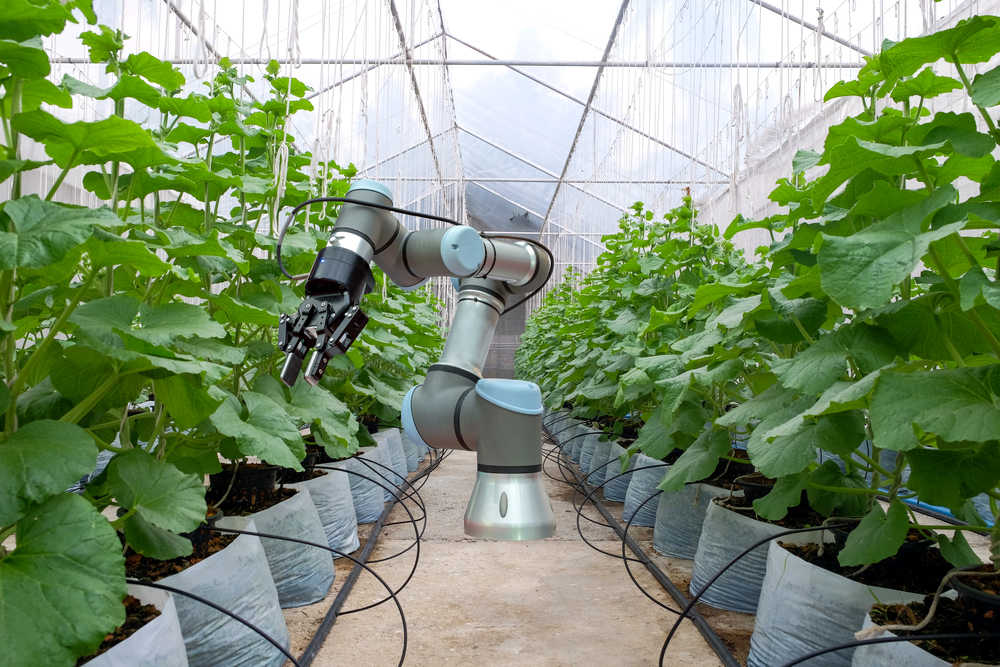
At the processing stage, AI-based solutions accurately sort fruit and vegetables based on size and weight, using high-tech cameras and laser scanners that can also analyse colour to establish food quality and separate it according to instructions. AI algorithms make accurate forecasts for inventory management, pricing, and shipping, leading to less waste and lower shipping costs. Consider that in the United States alone, a staggering 30% of all food and drink is discarded annually. Artificial neural networks can take care of the difficult task of accurately tracking and monitoring food shipments through all stages of the supply chain, ensuring that food products meet all safety standards through to their final destination.
On the subject of safety, compliance is top priority for all food producers. Food processing equipment is subject to strict hygiene rules, and an AI-controlled automated process can ensure a higher level of cleanliness, eliminating all possibility of human oversight while also reducing the energy and water consumption required for the cleaning process itself. Self-optimizing AI-driven cleaning systems use optical fluorescence imaging and ultrasonic sensors to identify microbes, germs, and food particles that are invisible to the human eye. On the production line, AI-enabled cameras can monitor hundreds of workers in real time, quickly identifying and reporting any safety issues or infringements of safety standards.
Crafting the Future of Food
AI is also changing how new food products are conceived, designed, and brought to market. Around 80% of new product launches fail, mainly due to consumer disinterest, so by leveraging predictive analytics and consumer data, AI can drastically reduce the trial-and-error process of product development. Through a deeper and more accurate understanding of consumer preferences, patterns, and trends, food manufacturers can develop products that align with target market demand, improving consumer satisfaction and success rates in product launches.
AI is also a game-changer in ingredient innovation, with the traditionally slow and resource-intensive approach now being transformed by AI’s ability to quickly identify and develop new, sustainable ingredients, pushing the boundaries of what is achievable in taste, nutrition, and ecological impact.
A Question of Taste
The taste of industrialised and processed food is mainly due to flavouring substances that recreate agricultural products, which was traditionally the work of biochemists, flavourists, and application chefs. In August 2023, researchers unveiled AI software that has learned to recognise the flavour and aroma of the industry’s 5,000 known compounds, based on their chemical and molecular structure. The next step could be the concoction of new tastes as yet unknown to human sensory perception, disrupting the world of cuisine as we know it.
AI’s role in food production is pivotal, marking a shift towards more intelligent and sustainable practices. In the rapidly evolving landscape of food production, and with a growing global population to feed, we need to embrace emerging technologies in this sector. The applications of AI-based technologies can be surprising and unexpected, but this only reminds us of its immense and exciting potential, as yet to be fully explored.

 Evgeny Kireev